Home / Applications / Markets / Traffic
Traffic
Automation has become a more important issue not only in the industry sector, but also in the public traffic sector, mainly in order to simplify processes, master the treatment of huge traffic data information flows and make processes more reliable and safer.
As traffic is continuously increasing, it is necessary to automatically monitor different situations on the road, whether lane control, vehicle counting, traffic light detection, pedestrian monitoring, etc.
For example automated processes are still used on toll stations or motorways for automatic vehicle classification and traffic data acquisition.
As a result, specific sensing systems are required for such purposes.
Task
A few examples:
-
Automated toll stations : In order to automate the payment of toll fees on highways, vehicles of different sizes have to be detected and classified so that the toll fee can be determined and subsequently be paid automatically. Vehicles of different heights and lengths needs to be detected and classified. The sensing system should allow to make the difference between cars with or without trailers, trucks, mobile homes, motorbikes, ...
- Traffic data acquisition systems: Traffic data are used for a very wide range of purposes, as for example to analyse specific traffic situations or analyse the behaviour of traffic participants in order to improve or optimize the traffic flow. Therefore, vehicles of different types, trucks, pedestrians, motorbikes or cyclists have to be detected and classified.
Solution
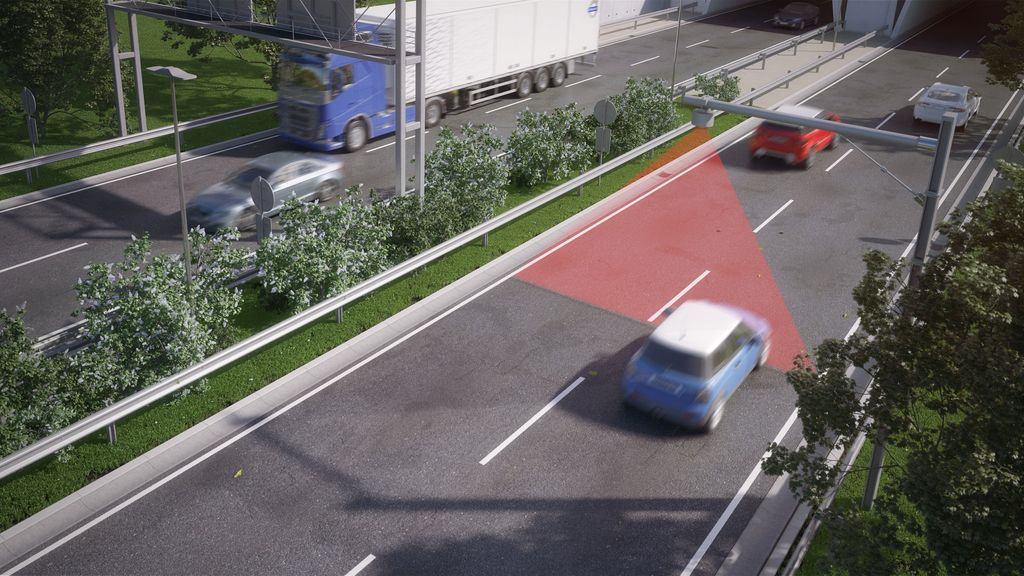
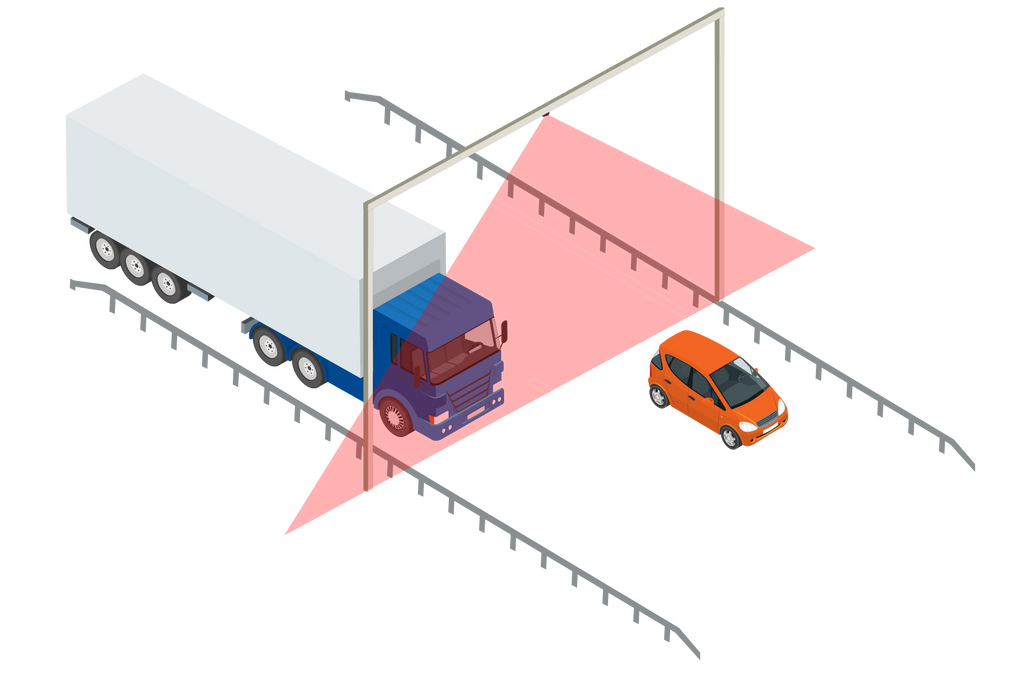
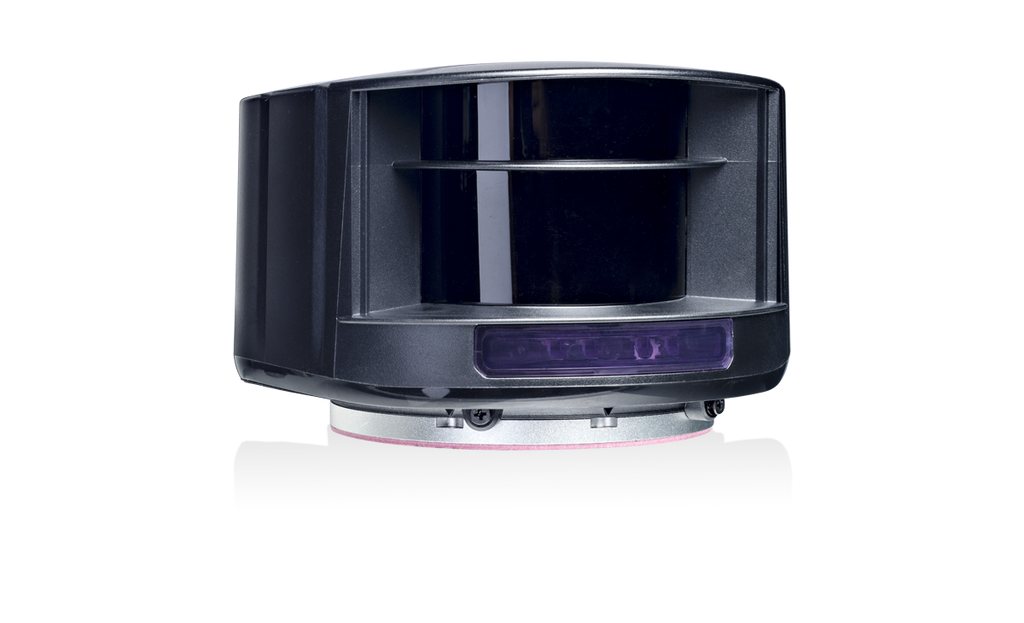
The LASER scanner platform LZR, and in particular the raw data laser scanner system LZR®-U901 can be used for this kind of applications. In fact, the LZR®-U901 allows to take the profile of objects of different sizes by communicating the raw measurement data for further calculations to the user through a RS485 communication bus. The LZR®-U901 can be mounted above the road in order to scan vehicles or pedestrians vertically.
For toll applications for example, by using a dedicated software, a system based on the LZR®-U901 can therefore detect vehicles of different types, such as cars, trucks or mobile homes and classify them according to the length, height and width dimension.
Thanks to its four scanning plans the LZR®-U901 can not only provide two dimensional information, but even three dimensional, and can also allow to detect the sense of travel. Its 90° scanning angle allows monitoring one lane at least. Depending on the situation and mounted properly, the LZR®-U901 can possibly monitor two lanes in parallel.
The LZR®-U901 is designed to provide the user with the highest degree of flexibility.
Customer benefits
Having the emitter and the receiver built in i one housing and mounting the system above the road reduces the installation cost to a large extent, e.g. compared to light curtains and induction loops.
Mounting above the roads also reduces the risk of dirt and damage compared to light curtains, which are generally mounted alongside the road, and more exposed to direct pollution.
Covering two lanes simultaneously is an additional advantage compared to conventional systems, such as light grids or inductive loops.
Furthermore, thanks to its scanning method, i.e. Time-Of-Flight, the sensor is less sensitive to background or substrate compared to light grids or other standard infrared sensing solutions. By using dedicated software, the sensor can also discard interferences due to the environment (such as snow, rain,). The LZR®-U901 can be used in all weathers.